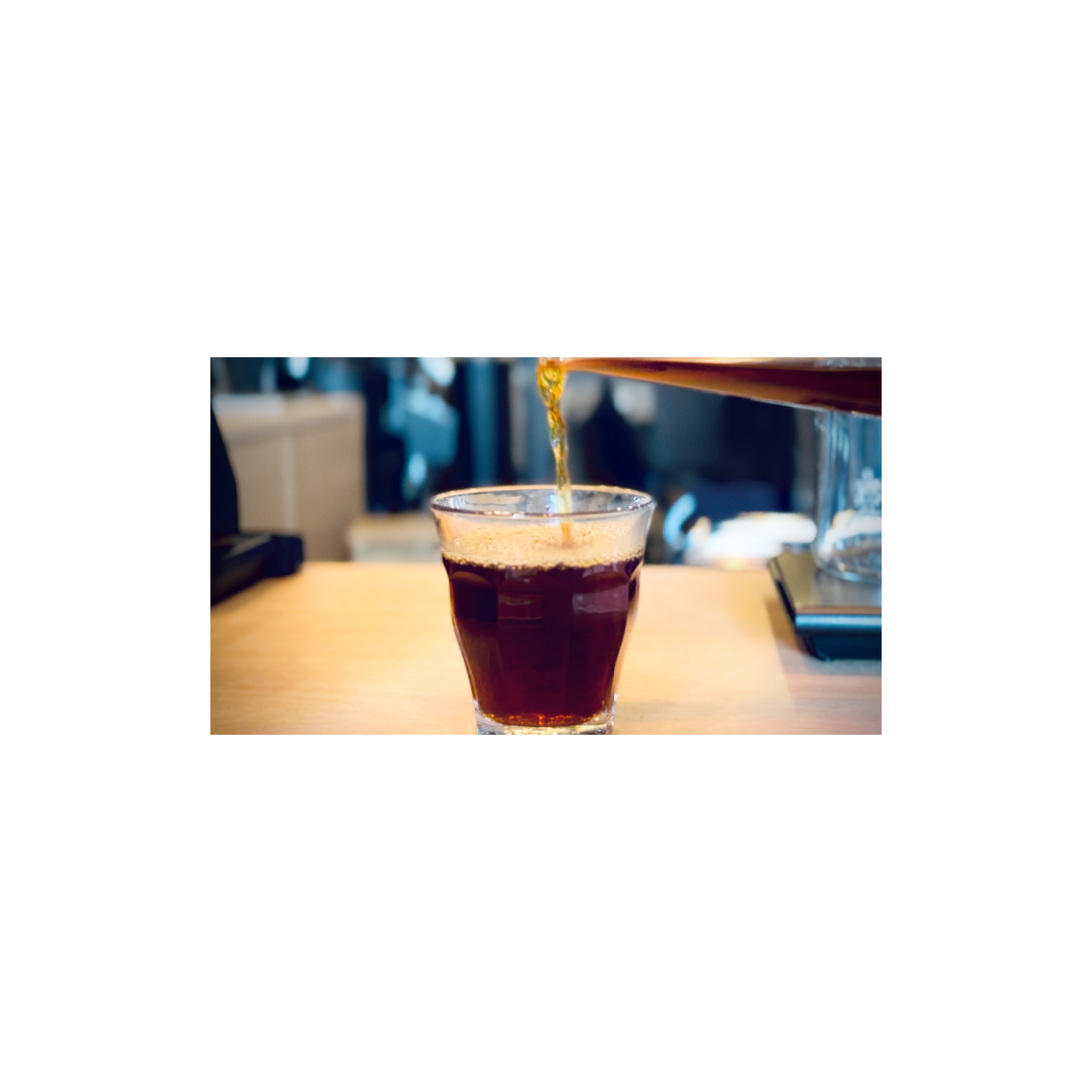
How to brew Geisha and light roast coffee.
How to Brew: Geisha +
How to brew delicious Geisha and light roast coffee
Here, we will briefly introduce some tips for brewing Geisha and other light roast coffees even more deliciously, as well as some of the approaches and basic ideas behind how THE WORD COFFEE adjusts light roast coffee.
Adjusting extraction based on varietal and processing method
GEISHA: Geisha varietal
The Geisha varietal is characterized by a floral and elegant aroma reminiscent of jasmine. The strong and delicate aroma and flavor of Panamanian Geisha, in particular, are exceptional, boasting the highest cup quality among countless specialty coffees.
On the other hand, if the delicate Geisha varietal is extracted incorrectly, the aroma may be good, but the cup tends to feel somewhat lacking.
To further emphasize the aroma, fragrance, and flavor of the Geisha varietal, try increasing the water temperature slightly higher than usual, and if you're looking for more body (concentration), try using slightly more coffee grounds. (This excludes Geisha with special processes such as anaerobic.)
ANAEROBIC+: Anaerobic and other special fermentation/processing methods
Anaerobic and other special fermentation processes are refining methods carried out to further emphasize the individuality and taste of the raw material. However, because they have stronger aromas and flavors compared to coffee refined by conventional methods, using your usual extraction recipe can result in a heavy and cloying cup. If you feel this way, try making your grind slightly coarser than usual or changing the ratio. Lowering the water temperature (85-88°C) is also effective.
While it's not a hard and fast rule, generally, for coffees with delicate flavors from traditional processes, we increase extraction efficiency, and for coffees with strong flavors from anaerobic or other special processes, we adjust to decrease extraction efficiency.
To express all the unique and characteristic flavors of each coffee in a single cup as much as possible, we subtly adjust the extraction method for each brand. This can involve water temperature, grind size (particle size of the grounds), or ratio, among other things.
One of the charms of light roast coffee is that even slight adjustments can lead to significant changes in flavor.
Click here for a more detailed explanation
Approach to light roast coffee
Basics
The components (flavors) of coffee are roughly extracted in the order of acidity → sweetness → bitterness → astringency. If you are using a typical pour-over dripper, finish the extraction within 2 minutes if you want to emphasize acidity, and within 3 minutes if you want to bring out sweetness. For light roast coffee, the bitter components are minimal, and if you spend more than 3 minutes extracting, astringency will emerge, so please adjust the extraction time to achieve your preferred taste.
The ratio of coffee grounds to water is called the brew ratio, and it is an important variable in extraction. For specialty coffee, a drip ratio of 1:15 to 1:17 (grounds:water) is common. This can vary depending on the roast level, varietal, brewing equipment, and recipe, but first, use this value as a baseline and gradually add variables, adjusting to achieve your preferred taste.
Taste
It is said that the temperature at which the human palate can perceive the most flavor is around 70-60°C. Generally, light roast coffee is extracted at a high temperature (90-95°C). While it is delicious immediately after being poured into a cup (around 80°C), this is not the ideal temperature for taste perception. Enjoy the aroma and fragrance of hot coffee, and by tasting it once it has cooled to an appropriate temperature, you will be able to fully experience all the flavors contained in the cup.
Aging
Lightly roasted coffee beans have hard cells, and it is difficult for gases generated during roasting to escape, which can hinder extraction. Therefore, we recommend letting the beans rest for at least a week after roasting (aging).
By making just a small adjustment, deliberately changing the approach to suit that particular coffee, you might be able to brew a more delicious light roast coffee than usual.
-The extraction methods described above are based on THE WORD COFFEE's roast and recipes.
About the Geisha varietal
Discovered in 1931 near Gesha village in the Bench Maji Zone of Ethiopia, it is an indigenous Ethiopian varietal. It was brought to Costa Rica via Kenya and Tanzania, and finally arrived in Panama. Cultivation of the Geisha varietal in Panama began around the 1960s, but its cultivation was difficult, and various factors led to a gap of about 40 years. The turning point came in 2004. When the Peterson family of Panama entered their Geisha varietal in the "Best of Panama" competition and auction, it received extremely high evaluations for its incredible flavor and was sold at auction for a record-breaking $20 per pound. Since then, Panamanian Geisha has continued to fetch high prices at auction, and despite its high cost, it continues to fascinate coffee lovers worldwide. It is now cultivated in various parts of the world.